

In 2026, successful SMEs understand that marketing budget allocation is more than just dividing money across popular channels: it’s about building a strategic path from awareness to cash flow.
While many consider this purely a financial exercise, smart budget allocation has deeper strategic roots than most business owners realise.
In this article, we discuss this concept in full, with insights from our marketing strategists here at Pandora Agency Limited, as well as real-life frameworks we’ve implemented for growing businesses.
Why Most SME Marketing Fails
Walk into any SME owner’s office, and you’ll likely hear the same frustration: “We’re spending money on marketing, but we’re not seeing results.”
The real issue isn’t the quality of the creative work. Most SME marketing fails because they have an unclear offer plus no path to cash.
Traffic doesn’t equal revenue. Likes don’t pay bills. Brand awareness without conversion strategy is just expensive entertainment.
Here’s the question every SME must answer before spending a single naira: What exactly are you selling, to whom, and why should they act now?
To take a deeper look into how to allocate your marketing budget based on strategy, profitability, psychology, and growth stage, let’s explore further.
How to allocate your SME marketing budget Without Wasting Money
1. Start With the Offer (Before You Spend ₦1 or $1)
“Budget allocation doesn’t start with choosing between Facebook and Google Ads. It starts with absolute clarity about what you’re selling and why it matters,” says Chijindu Nwankwo, our Lead, Innovation and Strategy, Pandora Agency.
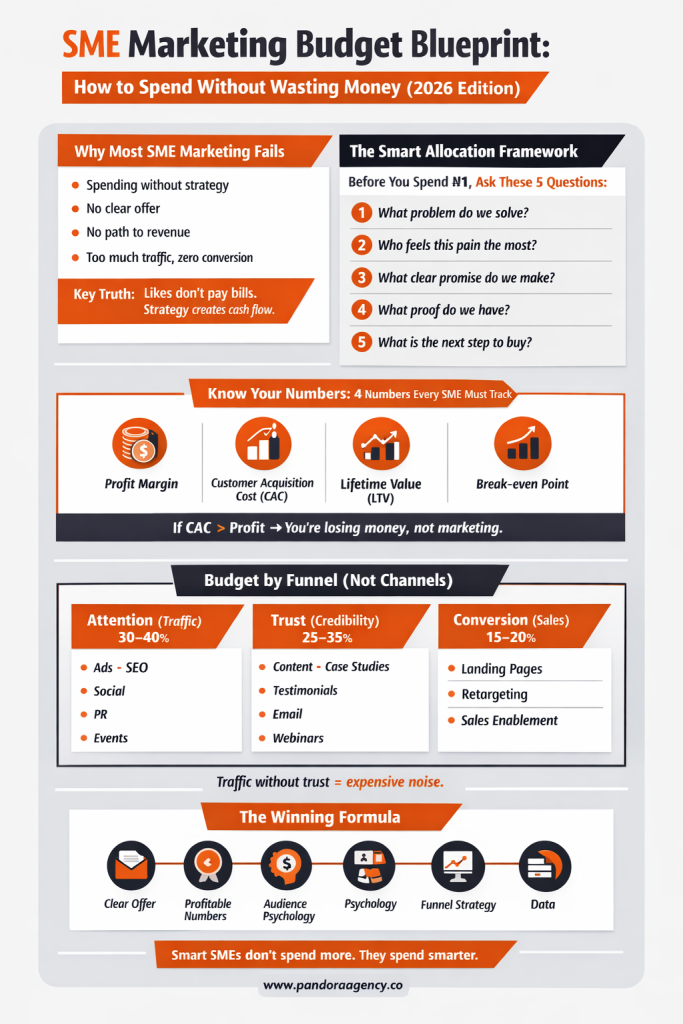
Before you open your wallet for any marketing activity, answer these four critical questions:
a. What problem are you solving? Not what features you offer, but what pain you eliminate or what gain you create. If you can’t articulate this in one sentence, your marketing budget will struggle to work efficiently.
b. Is the product proven in the market? There’s a massive difference between marketing a proven solution and marketing an experimental one. Your budget allocation must reflect this reality.
c. What makes your offer different? And “quality” or “customer service” don’t count because everyone claims that. What’s your genuine point of differentiation that customers actually care about?
A real differentiator must be specific, verifiable, hard to copy, valuable to buyers, and tied to a real pain or outcome. For example, at Pandora, we combine paid ads with direct B2B partnerships and industry events, not just digital, and that’s a real differentiation.
d. Why should someone act now? Without urgency or clear reason to act today rather than next month, your marketing spend will generate interest but not conversions.
Here’s a truth that saves SMEs thousands: No offer clarity equals wasted ad spend.
A clean value proposition beats fancy creative every single time. Marketing amplifies clarity; it cannot fix confusion.
The Mini Framework: Five Questions Before Budget Allocation
Before allocating a kobo or pence to any marketing channel, run your offer through this filter:
- Problem: What specific pain does this solve?
- Persona: Who experiences this pain most acutely?
- Promise: What transformation do you deliver?
- Proof: What evidence shows you can deliver this?
- Path to action: What’s the clearest next step?
If you struggle to answer any of these five questions, pause your budget planning. Investing in marketing without offer clarity is like building a house on sand. When the rain comes, it crumbles!
2. Understand Profitability Before Budgeting
Here’s where most SMEs make their costliest mistake: they spend without knowing their margins. That’s dangerous!
“We’ve seen businesses celebrate campaign ‘success’ based on leads generated, only to discover months later that they’re losing money on every customer acquired,” notes Chijindu Nwankwo.
Before you decide whether to spend ₦500,000 or ₦5 million on marketing, you must understand these four numbers:
a. Revenue vs Profit Margin: Many SMEs know their revenue but haven’t calculated their actual profit margin per product or service. This is non-negotiable information for budget allocation.
b. Customer Acquisition Cost (CAC): How much does it currently cost you to acquire one paying customer? If you don’t know this number, you’re flying blind. Understanding lead generation strategies is critical to managing this cost effectively.
c. Lifetime Value (LTV): What’s a customer worth over their entire relationship with your business? A customer who buys once for ₦50,000 is different from one who buys monthly for three years.
d. Break-even Math: At what point does a customer become profitable? Understanding this timeline shapes everything from patience to channel selection.
Let’s make this concrete with an example:
If your product profit margin is 30%, and your average sale is ₦100,000, you’re making ₦30,000 per customer.
Now, if your CAC is ₦35,000, you’re losing ₦5,000 on every customer you acquire through marketing. That’s unsustainable, regardless of how impressive your website analytics look or how viral your content goes.
The math is unforgiving: If your margin is 30%, your marketing budget must respect that constraint.
This section isn’t about limiting your ambition. It’s about positioning you as a strategist rather than just a creative. The most successful SMEs we work with treat marketing as an investment with expected returns, not an expense they hope works out.
Need help calculating your true marketing ROI? Our growth strategy team can walk you through the numbers.
3. Align Budget With Audience Psychology
Before choosing channels or setting budgets, answer these questions about your target audience:
a. What are they trying to fix right now? Not what you think they should want, but what keeps them up at night or frustrates them daily.
b. Are they problem-aware or solution-aware? Someone who knows they need accounting software requires different messaging than someone still using Excel and complaining about tax season.
c. What tone resonates with them? A 28-year-old tech founder and a 55-year-old manufacturing CEO require completely different communication styles.
d. Where do they actually hang out? Not where you assume or where it’s trendy to advertise, but where they genuinely spend time and attention.
Here’s an important angle that saves SMEs considerable money: Sometimes the best channel isn’t digital.
Selling B2B enterprise solutions? Industry conferences plus strategic partnerships might outperform every digital channel combined.
Running a local service business? Referral systems plus targeted PR could deliver better ROI than any social media campaign.
Offering high-ticket consulting? Trust-building content and speaking engagements may be your most efficient path to clients.
According to research by McKinsey, B2B buyers use an average of six different interaction channels throughout their decision journey. But here’s what matters: those six channels vary dramatically by industry, company size, and buying stage. The most successful SMEs create integrated 360 marketing campaigns that reach customers at every touchpoint.
Your marketing budget should follow buyer behaviour, not only industry trends or what worked for a company in a different sector.
“We’ve seen SMEs waste millions trying to replicate consumer brand tactics for B2B audiences, or vice versa. The channel that works is the one where your specific audience actually makes decisions,” emphasised our Lead, Innovation and Strategy.
4. Allocate by Funnel Stage (Your Path to Cash)
This is where strategy transforms into structure. Most SMEs allocate budget by channel (₦X for Facebook, ₦Y for Google), but successful businesses allocate by funnel stage.
Break your budget into three strategic layers:
a. Attention (Traffic)
This is the top of your funnel, getting discovered by people who have the problem you solve:
- Paid advertising (Google, Meta, LinkedIn)
- Social media presence
- SEO and content marketing
- Events and networking
- PR and media coverage
Budget allocation here depends on your growth stage. Established businesses might invest 30-40% here. Startups testing product-market fit might go as high as 50-60%.
b. Trust Building
This is your middle funnel, converting awareness into credibility and consideration:
- Educational content marketing
- Case studies and client stories
- Customer testimonials and reviews
- Email nurturing sequences
- Thought leadership and PR
- Social media for brand exposure
- Webinars and demonstrations
Here’s the crucial insight: Most SMEs overspend on traffic and drastically underinvest in trust-building.
They drive people to their website, then wonder why conversion rates sit below 2%. The answer? No trust layer. No reason to believe. No evidence of capability.
Smart SMEs allocate 25-35% of budget here, understanding that trust is the bridge between awareness and purchase.
c. Conversion
This is your bottom funnel, turning interested prospects into paying customers:
- Optimised landing pages
- Clear, compelling offers
- Sales enablement tools and scripts
- Retargeting campaigns
- Conversion rate optimisation
- Sales team support and training
Budget allocation at this stage isn’t about spending more, it’s about removing friction. Even 15-20% invested here often delivers the highest ROI because you’re optimising what’s already working rather than acquiring cold traffic.
That’s why campaigns look good but don’t sell, they’re top-heavy with traffic, thin on trust, and weak on conversion. This is why working with lead generation specialists can make such a significant difference.
5. Choose Strategically Between Digital vs Non-Digital
Here’s where we challenge conventional wisdom.
Every year, industry reports tout the latest digital marketing statistics, creating pressure for SMEs to go “all in” on digital. But the data tells a more nuanced story.
Sometimes cold calls outperform Instagram. Sometimes partnerships beat paid ads. Sometimes, connections made at golf clubs deliver better ROI than Google Ads for certain industries.
A high-ticket B2B brand burning ₦2 million monthly on LinkedIn ads with minimal results can shift 60% of that budget to industry conference sponsorships and executive dinners. Their lead quality can increase by 300%, and their cost per qualified lead can drop by 65%. Ads work, but not always.
The lesson? Study where your audience actually spends time and where ROI is realistic. This leads us to the three-part budget rule:
The Three-Part Budget Rule
Invest where:
- Attention exists: Your audience must actually be present and receptive
- Trust can be built: The channel must allow for credibility development
- Profit margin supports it: The economics must make sense for your business model
A luxury real estate company shouldn’t allocate budget the same way a D2C skincare brand does. A manufacturing equipment supplier needs different channels than a subscription software company.
According to Gartner research, B2B buyers spend only 17% of their purchase journey with sales reps when considering multiple suppliers. The rest of that journey happens across digital research, peer recommendations, and independent evaluation.
But, and this is critical, that 17% face-to-face time often closes the deal. Smart budget allocation funds both the 83% (content, SEO, nurturing) and the 17% (events, relationship building, sales enablement).
6. Avoid the Impatience Trap
Let’s address the elephant in every SME marketing meeting: “How long until we see results?”
This question, while understandable, reveals a fundamental misunderstanding of what marketing actually is.
Marketing is not a one-month experiment. It’s not a quick cash hack. It’s not a silver bullet you fire once and watch sales explode.
Marketing is a system. It’s a compounding engine. It’s a long-term trust builder.
Here are realistic timelines that successful SMEs accept:
- SEO: 6-12 months before you see significant organic traffic gains. Building an effective SEO strategy requires patience and consistent execution.
- Brand trust: Ongoing investment that builds equity over years, not quarters
- Paid ads: Fast traffic, but requires 3-6 months of optimization to become profitable
- Content marketing: 4-9 months before content library generates consistent leads. Quality content writing and strategy is essential for long-term success.
- PR and thought leadership: 6-18 months to establish credibility that drives referrals
“The most common way SMEs waste money isn’t choosing the wrong channels. It’s killing campaigns too early, chasing trends without strategy, and expecting instant results from long-term tactics,” says Chijindu Nwankwo.
We’ve seen this pattern repeatedly: A business invests in content marketing, produces quality work for three months, sees modest results, gets impatient, and abandons the strategy right before it would have compounded.
Meanwhile, their competitor maintains the same strategy for 18 months and builds an asset that generates leads for years.
The impatience trap costs SMEs more money than any other single mistake. So what should an SME do?
The Patience-Speed Matrix
Here’s how to think about channel timing:
Quick wins (1-3 months): Paid advertising, retargeting, email to existing lists, referral programs
Medium term (3-9 months): SEO, content marketing, social media growth, partnership development
Long term (9-24 months): Brand building, thought leadership, community development, PR
Smart budget allocation funds all three timeframes simultaneously, creating both immediate revenue and future assets.
7. Data Is Not Optional
If you take one thing from this guide, let it be this: If you don’t measure, you’re gambling, not marketing.
Every naira or dollar you invest in marketing should be tracked with the same rigour you apply to inventory, payroll, or equipment purchases.
Track these metrics at minimum:
- Customer Acquisition Cost (CAC): Total marketing spend divided by new customers acquired
- Conversion rates by channel: Which sources deliver the highest percentage of sales
- Channel performance: ROI of each marketing investment, not just traffic or likes
- Customer Lifetime Value (LTV): How much revenue each customer generates over time
- Time to conversion: How long from first touch to purchase (shapes patience and budget)
If an SME is spending ₦800,000 monthly across five channels. They should be able to tell which channel delivered ROI. Through tracking, they can discover the channels that are losing money and the ones breaking even. Sometimes, reallocating the entire budget can lead to revenue increase without spending an additional naira.
Therefore, invest in analytics infrastructure. Use UTM parameters. Implement conversion tracking. Review dashboards monthly. Adjust strategy quarterly based on data.
Without measurement, you’re making budget decisions based on feelings, opinions, and whoever spoke last in the meeting. With data, you’re making decisions based on reality.
Budget allocation should adjust based on performance data quarterly, doubling down on what works, cutting what doesn’t, and testing new opportunities with small percentages of budget.
8. Marketing Plan Comes Before Branding
Here’s a perspective shift that changes everything: Don’t create a marketing plan for your website. Create a website that fits into your marketing plan.
Most SMEs approach it backwards. They build a beautiful website, social media pages, services, etc. then ask, “How do we market this?”
The right sequence is:
- Strategy first: What are we selling, to whom, and why
- Channels second: Where will we reach them and build trust
- Creative third: What assets do we need (including website) to execute this strategy
Your website, ads, content, social media presence, all must serve the strategy. They’re not the strategy themselves.
“A ₦5 million website without a marketing strategy will generate the same results as a ₦500,000 website without a strategy: not much. But a ₦500,000 website built to serve a smart strategy will outperform both,” says our creative Lead, Eseoghene Morrison.
This principle extends to every budget decision. Don’t ask “Should we invest in Instagram?” Ask “Does Instagram serve our strategy for reaching and converting our target audience?”
The strategy directs where money flows. The channels are simply vehicles for executing that strategy.
9. Know When to Hire an Agency vs Go In-House
As your marketing budget grows, you’ll face this question: Should we hire an agency or build an internal team? There’s no universal answer, but here are frameworks for making this decision:
Outsource to an Agency When:
a. You lack internal expertise: Marketing requires specialised skills (SEO, paid ads, analytics, creative). Building this in-house takes years and significant salary investment.
a. You need performance marketing quickly: Agencies bring tested frameworks and experience across multiple clients and industries.
c. You want faster testing and learning: Agencies can run experiments and optimise campaigns more efficiently than most in-house teams starting from scratch.
d. You’re scaling and need flexibility: Agencies can scale efforts up or down based on business needs without hiring and firing full-time staff.
e. You need diverse capabilities: Good agencies offer strategy, creative, analytics, and execution under one roof.
Build In-House When:
a. You have consistent, full-time volume: If you’re producing content daily and running campaigns continuously, in-house teams often become more cost-effective at scale.
b. You have a strong internal marketing culture: Some businesses succeed by building marketing as a core competency, not an outsourced function.
c. Your industry is highly specialized: If your sector requires deep domain knowledge that’s rare in agencies, in-house might be necessary.
d. You’re ready for significant investment: Building a quality in-house team means competitive salaries, tools, training, and management infrastructure.
Many successful SMEs use a hybrid model: agency for strategy and specialized execution, in-house for content production and daily management.
At Pandora Agency, we help SMEs design profitable marketing systems, not just campaigns. We believe in building strategies that work whether we’re executing them or training your team to do so.
The Real Formula for Marketing Budget Allocation
Marketing budget allocation is not about copying competitors, chasing trends, or hiring the cheapest agency willing to promise results.
It’s about building a system based on:
Clear Offer: What you’re selling and why it matters must be crystalline
Profitable Model: The economics must work (margin, CAC, LTV, and timeline)
Audience Alignment: Budget flows where your specific audience actually makes decisions
Funnel Structure: Investment across attention, trust, and conversion, not just traffic
Patience: Realistic timelines matched to channel characteristics and business goals
Data: Measurement, analysis, and optimization based on performance, not assumptions
This formula equals predictable growth.
Not overnight success. Not viral moments. Not marketing magic.
Predictable, sustainable, profitable growth that builds over time and compounds.
SME Marketing Budget blueprint (printable)
Your Next Steps
Whether you’re a startup allocating your first ₦500,000 in marketing spend or an established SME managing millions in annual marketing budget, these principles scale to fit your needs and stage.
The key is commitment to clarity over creativity, strategy over tactics, and data over opinion.
At Pandora Agency, we specialise in creating comprehensive marketing systems that meet customers wherever they are, with the right message, at the right time, in the right format, backed by financial accountability.
We’ve helped SMEs across Nigeria transform marketing from a cost centre they hope works out into a growth engine they can forecast and scale.
Ready to create your own marketing success story? The path begins with a conversation.
Book a Free 30-Minute SME Growth Strategy Call or Download Our SME Marketing Budget Planner to start allocating your budget strategically.
Because in 2026, the SMEs that win are the ones spending the smartest.
How much should an SME spend on marketing in 2026?
SMEs should typically allocate 7-12% of gross revenue to marketing, but the exact percentage depends on your growth stage and industry. Startups and businesses in growth mode may invest 12-20%, while established businesses maintaining market share might allocate 6-9%. However, the percentage matters less than the strategy behind it. A well-allocated ₦500,000 following the funnel approach (attention, trust, conversion) will outperform ₦2 million spent without strategy. Always ensure your Customer Acquisition Cost (CAC) is lower than your customer Lifetime Value (LTV), and that your profit margins can sustain your marketing investment.
What is the biggest mistake SMEs make when allocating marketing budgets?
The biggest mistake is overspending on traffic generation (top of funnel) while drastically underinvesting in trust-building and conversion infrastructure (middle and bottom of funnel). SMEs often allocate 60-70% of budget to paid ads and social media to drive traffic, then wonder why conversion rates sit below 2%. The truth is, people don’t buy from brands they just discovered,they buy from brands they trust. Smart budget allocation follows the complete customer journey: 30-40% on attention/traffic, 25-35% on trust-building (case studies, content, testimonials, nurturing), and 15-20% on conversion optimization. This creates a complete path from awareness to purchase, not just expensive traffic that bounces.
How long does it take to see ROI from marketing budget allocation?
ROI timelines vary significantly by channel and strategy. Paid advertising can generate immediate traffic but requires 3-6 months of optimization to become profitable. SEO takes 6-12 months before you see significant organic traffic gains. Content marketing needs 4-9 months before your content library generates consistent leads. Brand-building and thought leadership require 6-18 months to establish credibility that drives referrals. The critical mistake SMEs make is killing campaigns too early, often abandoning strategies right before they would have compounded. Smart budget allocation funds quick wins (paid ads, retargeting), medium-term investments (SEO, content), and long-term assets (brand building, PR) simultaneously, creating both immediate revenue and future growth.
Should SMEs hire a marketing agency or build an in-house team?
The answer depends on your specific situation. Hire an agency when you lack internal expertise, need performance marketing quickly, want faster testing and learning, are scaling and need flexibility, or need diverse capabilities (strategy, creative, analytics) under one roof. Build in-house when you have consistent full-time volume, strong internal marketing culture, highly specialized industry knowledge, or are ready for significant investment in salaries, tools, and training. Many successful SMEs use a hybrid model: agency for strategy and specialized execution (like SEO or paid ads), in-house for content production and daily management. The key is ensuring whoever manages your marketing understands the principles in this guide: clear offers, profitable models, audience psychology, funnel structure, patience, and data-driven decisions.
Leave a Reply